Your website needs a voice before it needs words
If you don't know how your business sounds, your website will sound like everyone else's.

On this page
- The website project that goes a bit wrong
- What is a tone of voice and why does a website need one?
- Why does tone of voice matter for SEO in 2026?
- How has AI search changed website copy?
- How do you write website copy for SEO and AI search without sounding like a robot?
- Where do design and development come in?
- Why all three, early.
- What should you do before your next website project?
- The short version
- FAQs
- What's the difference between SEO, AEO and GEO?
- Do I need to rewrite my website for AI search?
- Can I use AI to write my website copy?
- Should website copy come before design?
- What is non-commodity content?
That's always been a problem. In 2026 it's an even bigger one, because Google and the AI tools people now search with are actively looking for the thing only you could have written. Generic copy doesn't just bore your visitors anymore, it gives search engines no reason to choose you.
I’m Danni, founder of Tweak (opens in new tab), a marketing consultancy for expertise-led businesses whose marketing undersells them. I’ve spent eight years in marketing, including three as Marketing Director at a family law barristers chambers, where I learned that you can follow every rule in a heavily regulated industry and still sound like a human being. These days, a lot of my work is the part of a website project that usually gets left until last: the words.
So I’m really glad to be part of this collaborative series with Alex at XIII Studios and Jade at Jaycee Creative (opens in new tab), about why a good website project needs three people in the room: someone on the words, someone on the look and someone on the build. I’m the word person, so I’m going to start where I think every website should start: with how you sound.
The website project that goes a bit wrong
You've finally decided it's time. Your website has been quietly embarrassing you for a while.
So you find a designer, you find a developer and you sign off a gorgeous homepage layout full of "Lorem ipsum" (that’s the placeholder text designers use before you add in your own words). Then, about two weeks before launch, somebody asks: "Who's doing the copy?"
And it ends up being you. At 9pm, writing "We provide bespoke solutions tailored to your individual needs" because it fits the box and you're too tired to think of anything better (or you asked AI to write it for you).
I've watched this happen more times than I can count. It’s not because business owners are lazy (far from it), it’s because copy gets treated as the bit that fills the gaps in the design, rather than the thing the design is there to carry. The result is a website that looks lovely and says absolutely nothing.
And in 2026, saying nothing has a real cost.
What is a tone of voice and why does a website need one?
A tone of voice is how your business sounds when it talks. The words you'd use, the words you'd never use, how formal you are and how much of your personality you let through.
"Professional, approachable, innovative" describes about 90% of the businesses in the UK.
Here's the test I use: if I covered up your logo, would your best client recognise the homepage as yours?
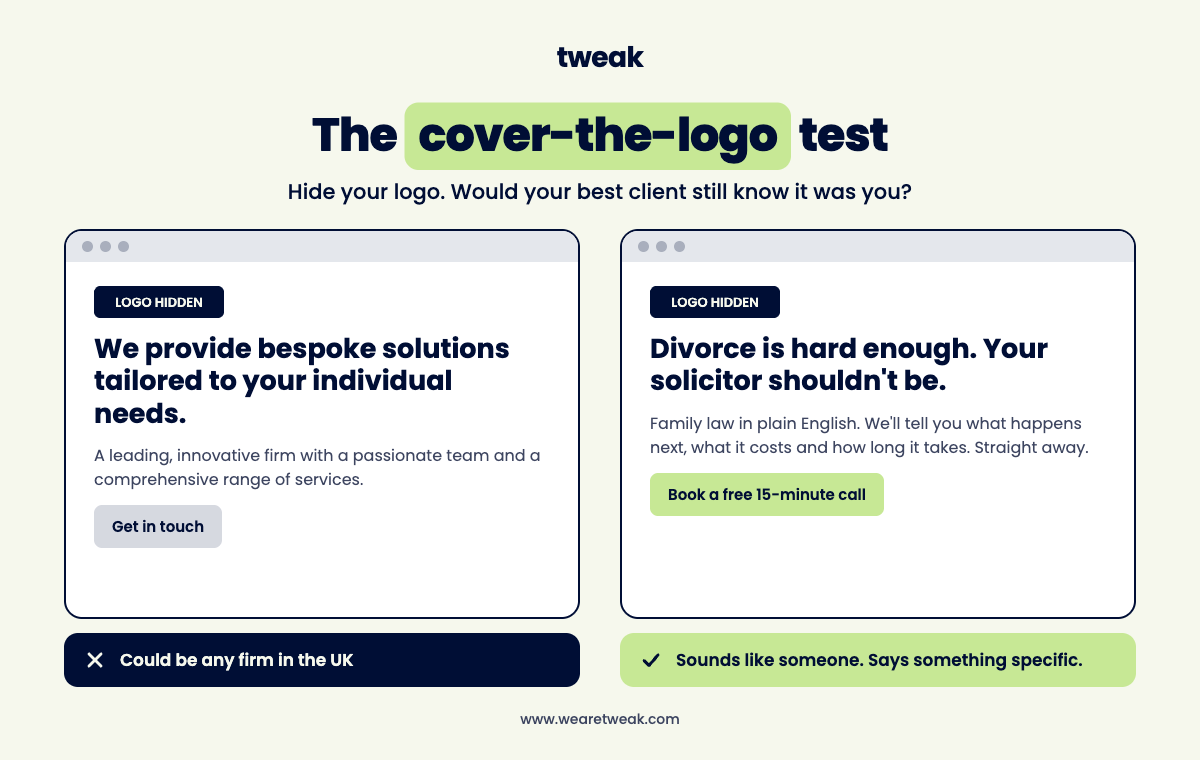
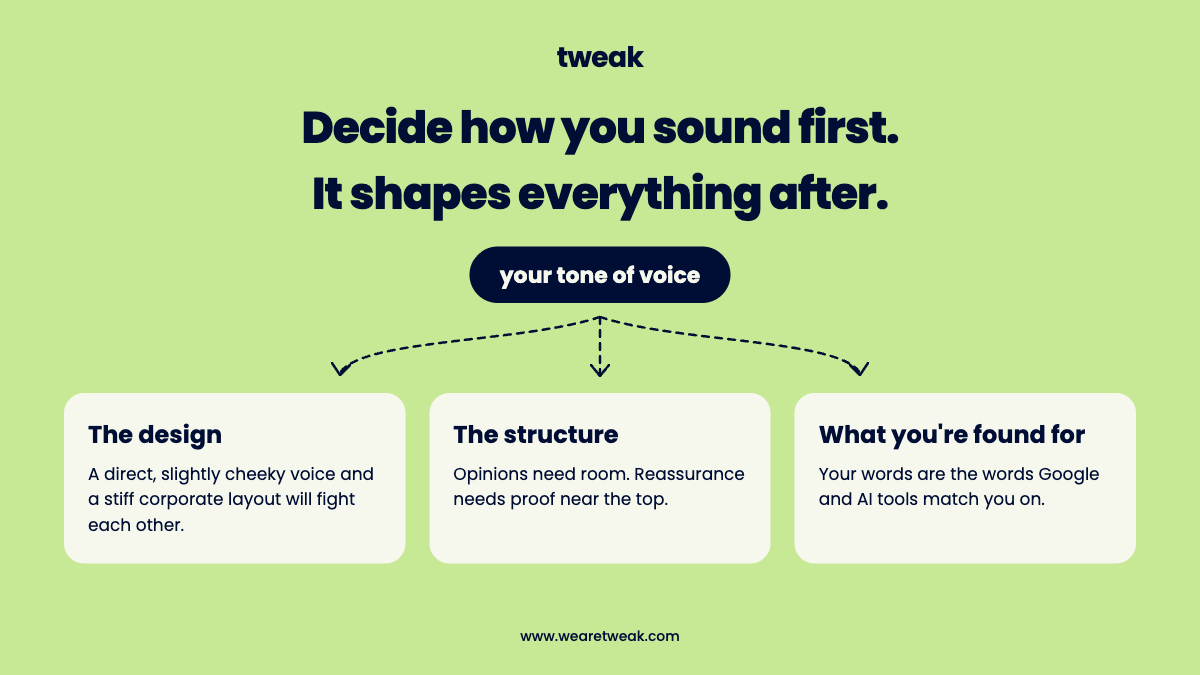
If the answer is no, the problem isn't the copy. It's that nobody decided what you sound like before the copy was written. That decision matters for the whole project, not just the words:
- It shapes the design: A direct, slightly cheeky voice and a stiff corporate layout will fight each other. Your designer needs to know which one you are before they pick a typeface.
- It shapes the structure: A voice that leads with opinions needs room for them. A voice that leads with reassurance needs proof near the top.
- It shapes what you're found for: The words you choose are the words search engines and AI tools match you on.
Why does tone of voice matter for SEO in 2026?
Because Google has more or less told us it wants content that only you could write.
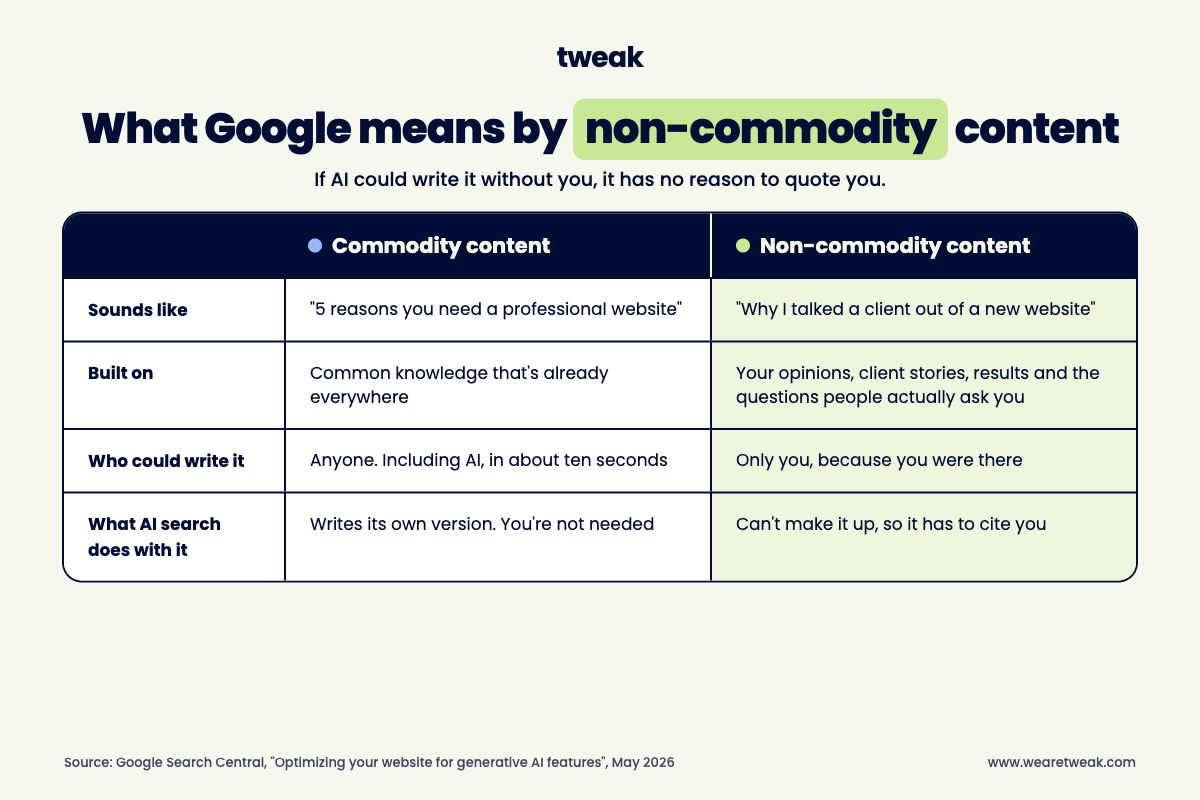
In May 2026, Google published its first official guide (opens in new tab) to its AI search features, AI Overviews and AI Mode. Two things in it stood out. First, it says that from Google's point of view, optimising for AI search is "still SEO". No secret formula and no new acronym you need to pay someone for. Second, it says the thing most likely to help you, more than any technical tweak, is content people find unique, compelling and useful. Google calls this "non-commodity" content.
Commodity content is the stuff AI could write without ever visiting your website. "5 reasons you need a professional website." "Why SEO matters for small businesses." There are thousands of them, and they all say the same thing. Non-commodity content is the stuff AI can't make up, because it wasn't there. Your opinion, your client stories, the question someone asked you on a call last Tuesday, the thing you strongly disagree with in your industry.
This is exactly why tone of voice matters for SEO. A real voice isn't just a style, it's what makes you say specific things in the first place. Businesses with a clear voice tend to have opinions, stories and examples. Businesses without one tend to fall back on the same safe sentences as everyone else, and those sentences are the easiest thing in the world for AI to replace.
How has AI search changed website copy?
Fewer people click through to websites, and the ones who do arrive further along in their decision.
The numbers are stark, although most of the research so far is from the US. SparkToro (opens in new tab) found that 68% of US Google searches in early 2026 ended without a click to any website. Pew Research (opens in new tab) found that when an AI summary appeared, people clicked a normal search result on about 8% of visits, compared with 15% when there wasn't one. Links inside the AI summary itself were clicked about 1% of the time.
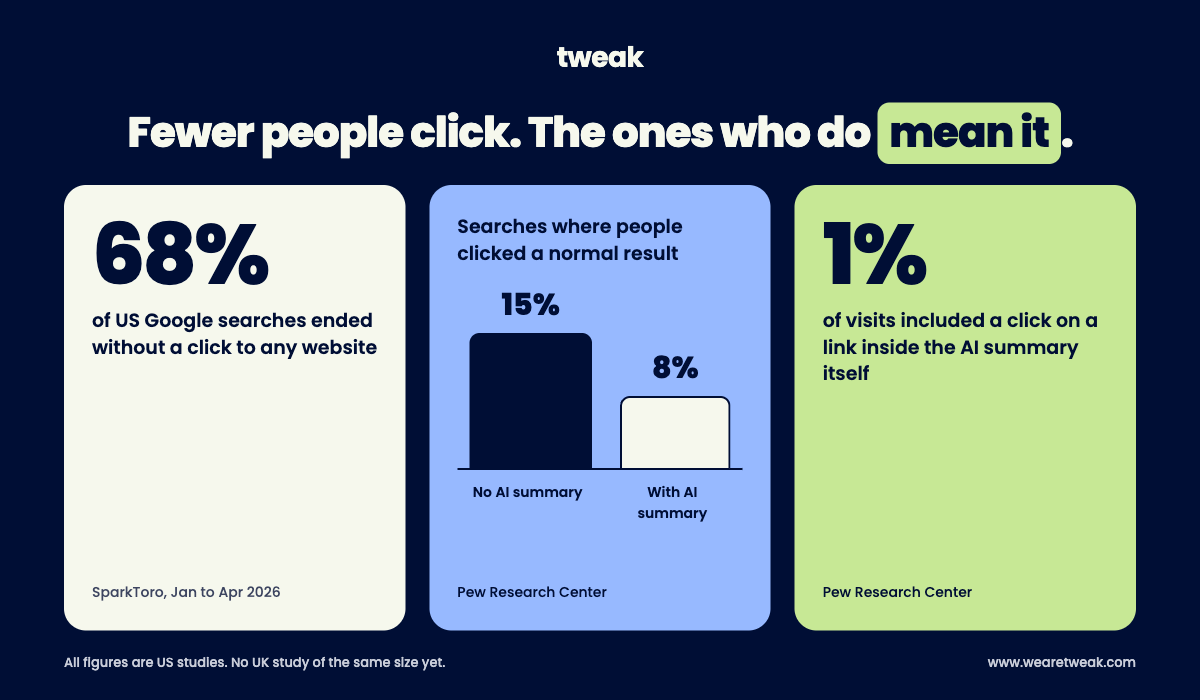
That sounds like bad news and I think it's mostly a shift in what your website is for.
If someone has already read an AI summary of "what does a marketing consultant do?", they don't need your website to explain the basics. When they do click, they're checking you out and they want to know:
- Does this person understand businesses like mine?
- Do I trust them?
- Would I actually enjoy working with them?
Those are emotional questions. You don't answer them with a list of services. You answer them with a voice that sounds like a real person who knows what they're talking about.
There's a second shift too. AI tools describe your business based on what's written about you. If your website is vague, the AI's description of you will be vague. If your website says the same thing in five different ways across five pages, it'll get confused. Clear, consistent copy helps people and machines understand you.
How do you write website copy for SEO and AI search without sounding like a robot?
Write like an expert talking to one person, answer their actual questions early, and be specific. Here's how I'd do it.
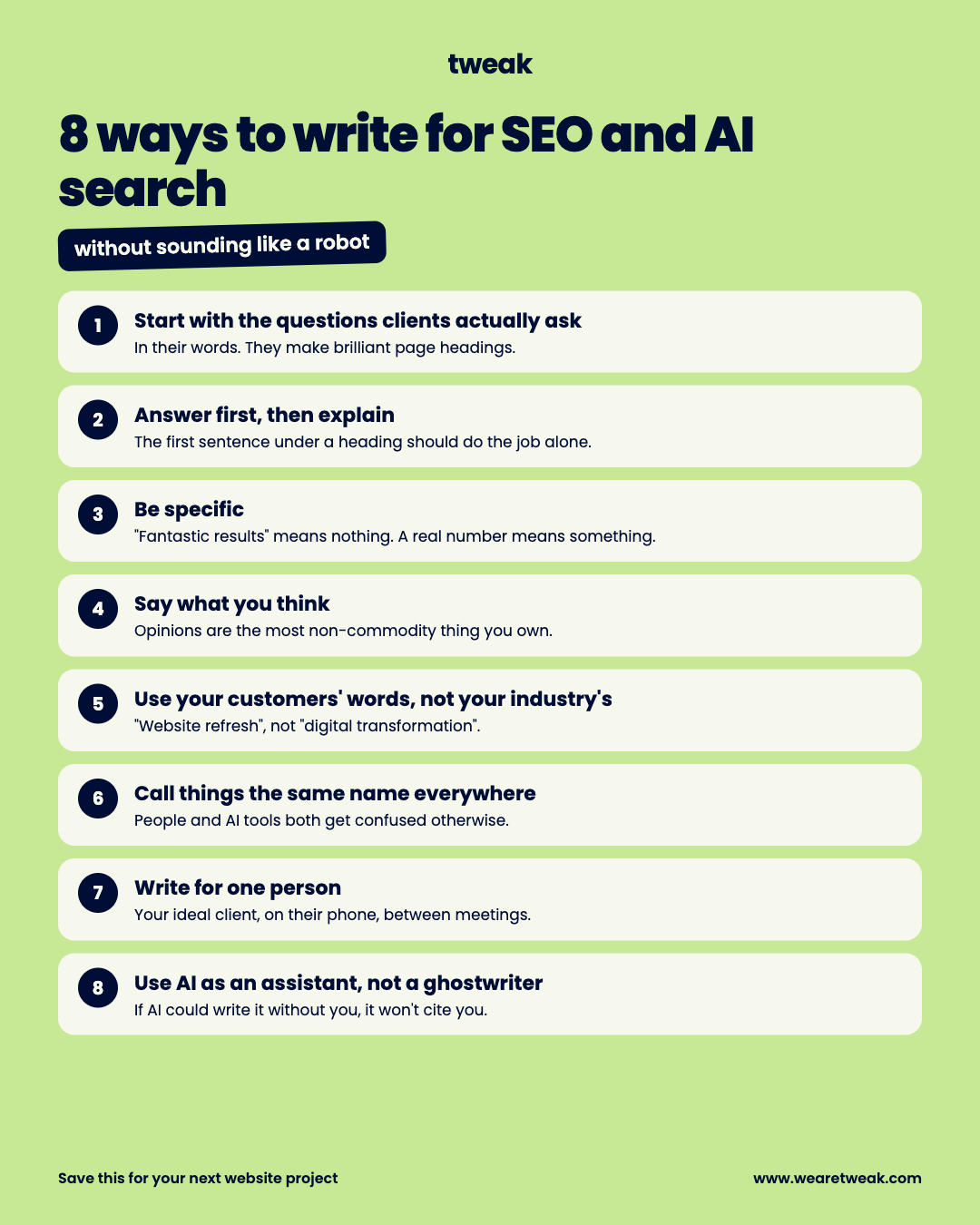
- Start with the questions clients actually ask you: Not the ones you wish they'd ask. Look at your emails and your notes from discovery calls. Those questions, in their words, make brilliant page headings. They're also very close to how people type questions into ChatGPT or Google.
- Answer first, then explain: The first sentence under each heading should do the job on its own. Search engines and AI tools lift those sentences. Busy humans skim them. Everyone wins.
- Be specific: "Fantastic results" means nothing. “When I did X, Y kind of work went from X% to Z%, and they now rank first locally for their main specialism”. Specific is believable and specific is also very hard to copy.
- Say what you think: Opinions are the most non-commodity thing you own. "I don't think every business needs a new website" will do more for you than "We deliver websites that drive results".
- Use your customers' words, not your industry's: Keyword research is really just listening at scale. If your clients say "website refresh" and you say "digital transformation", you're talking to yourself.
- Call things the same name everywhere: If your main service is a "Marketing MOT" on one page and a "marketing audit" on another, people and AI tools will both wonder if they're two different things.
- Write for one person: Picture your ideal client reading it on their phone between meetings. Cut anything they'd skip.
- Use AI as an assistant, not a ghostwrite: I use it to research, structure and challenge my thinking. I don't let it decide what I believe. If AI could have written your page without you, it has no reason to cite you.
If you work in a regulated industry, there's an extra temptation to strip everything back until it's safe and says nothing. Having worked inside a barristers chambers, I understand why. But being compliant and memorable aren't opposites, you can follow every rule and still sound like a human being.
Where do design and development come in?
Great copy on a badly designed, slow website is still a bad website. This is why I'm writing this as part of a series and not on my own.
Design (Jade, Jaycee Creative (opens in new tab)). Your tone of voice has a visual side. Colours, typefaces, photography and spacing all say something before anyone reads a word. If the copy is warm and direct and the design is cold and corporate, visitors feel the mismatch even if they can't name it. Good design also decides what gets read first, which is half the battle on any homepage. And Google's guide points out that its AI features pull in images and video too, so real photos of your work and your people now do more than stock images ever could.
Development (Alex, XIII Studios). None of this counts if search engines can't read it. Google is clear that to appear in its AI features, a page has to be crawlable and indexed like any other page. That means fast load times, clean code, proper headings that are actually marked up as headings, and content that isn't hidden behind clever scripts. Alex has written about why site speed matters and why accessibility matters, and both feed straight into this. An accessible website is easier for people and machines to understand.
Why all three, early.
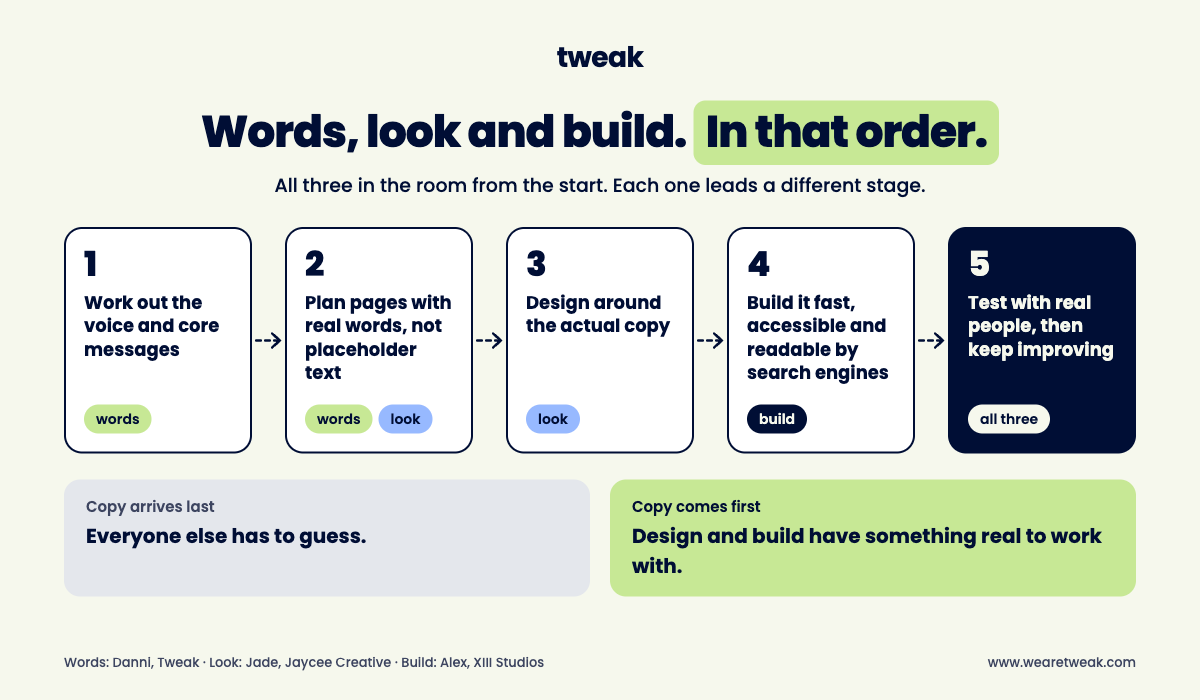
The best projects I've worked on bring the three of us in at the start, not one after the other. In the order I'd do it:
- Work out the voice and the core messages
- Plan the pages and structure using real words, not placeholder text
- Design around the actual copy
- Build it properly: fast, accessible and readable by search engines
- Test it with real people, then keep improving it
When the copy arrives last, everyone else has to guess. When it comes first, the design and the build have something real to work with.
What should you do before your next website project?
Answer five questions before you brief anyone. Even rough answers will save you weeks.
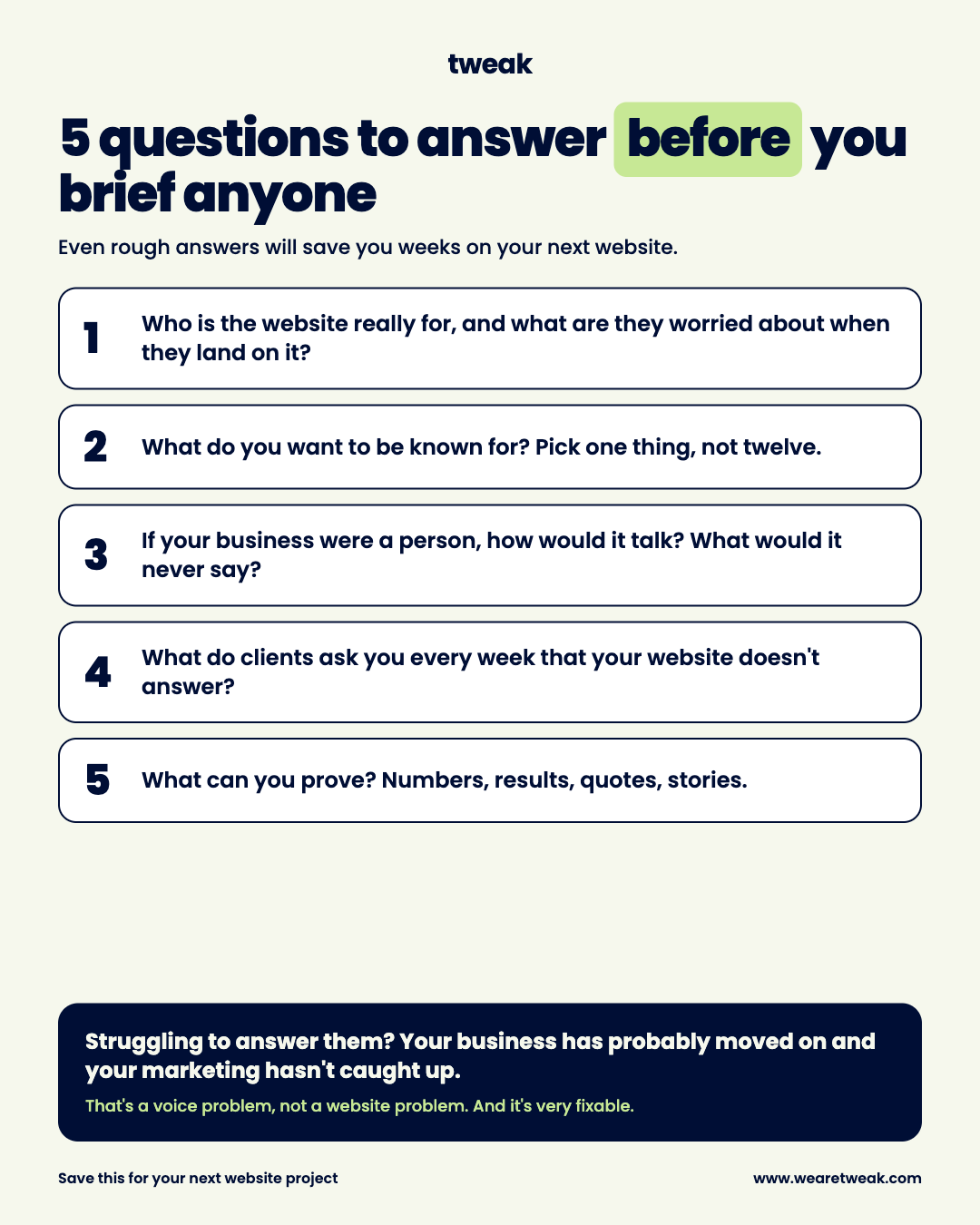
- Who is the website really for, and what are they worried about when they land on it?
- What do you want to be known for? Pick one thing, not twelve.
- If your business were a person, how would it talk? What would it never say?
- What do clients ask you every week that your website doesn't answer?
- What can you prove? Numbers, results, quotes, stories.
If those feel hard to answer, that's useful information in itself. It usually means the business has moved on and the marketing hasn't caught up. That's not a website problem yet, it's a voice problem, and it's very fixable.
The short version
Your business is probably better than your website makes it look. Most of the ones I work with are.
The fix isn't more pages, more keywords or a cleverer AI tool. It's deciding how you sound, saying things only you could say, and then giving that voice a design and a build that do it justice.
That's what Google is now rewarding and more importantly, it's what your future clients are looking for when they finally click.
If you're planning a website and want to get the words right first, get in touch with me at Tweak (opens in new tab). If it's the build that's worrying you, talk to Alex at XIII Studios. Ideally, talk to both of us. That's the whole point.
FAQs
What's the difference between SEO, AEO and GEO?
SEO is about being found in search results. AEO (answer engine optimisation) and GEO (generative engine optimisation) are newer terms for being quoted in AI answers from tools like Google's AI Overviews, ChatGPT and Perplexity. Google's own view is that optimising for its AI features is still SEO, built on the same foundations.
Do I need to rewrite my website for AI search?
Probably not from scratch. Most websites need clearer answers to real client questions, more specific proof and a consistent voice. Those changes help human visitors, Google and AI tools at the same time.
Can I use AI to write my website copy?
You can use it to research, plan and edit. Be careful letting it write the substance. Google rewards content only you could have created, and AI on its own produces the same safe sentences as everyone else.